
Cat sitting vs boarding: should your cat stay home?
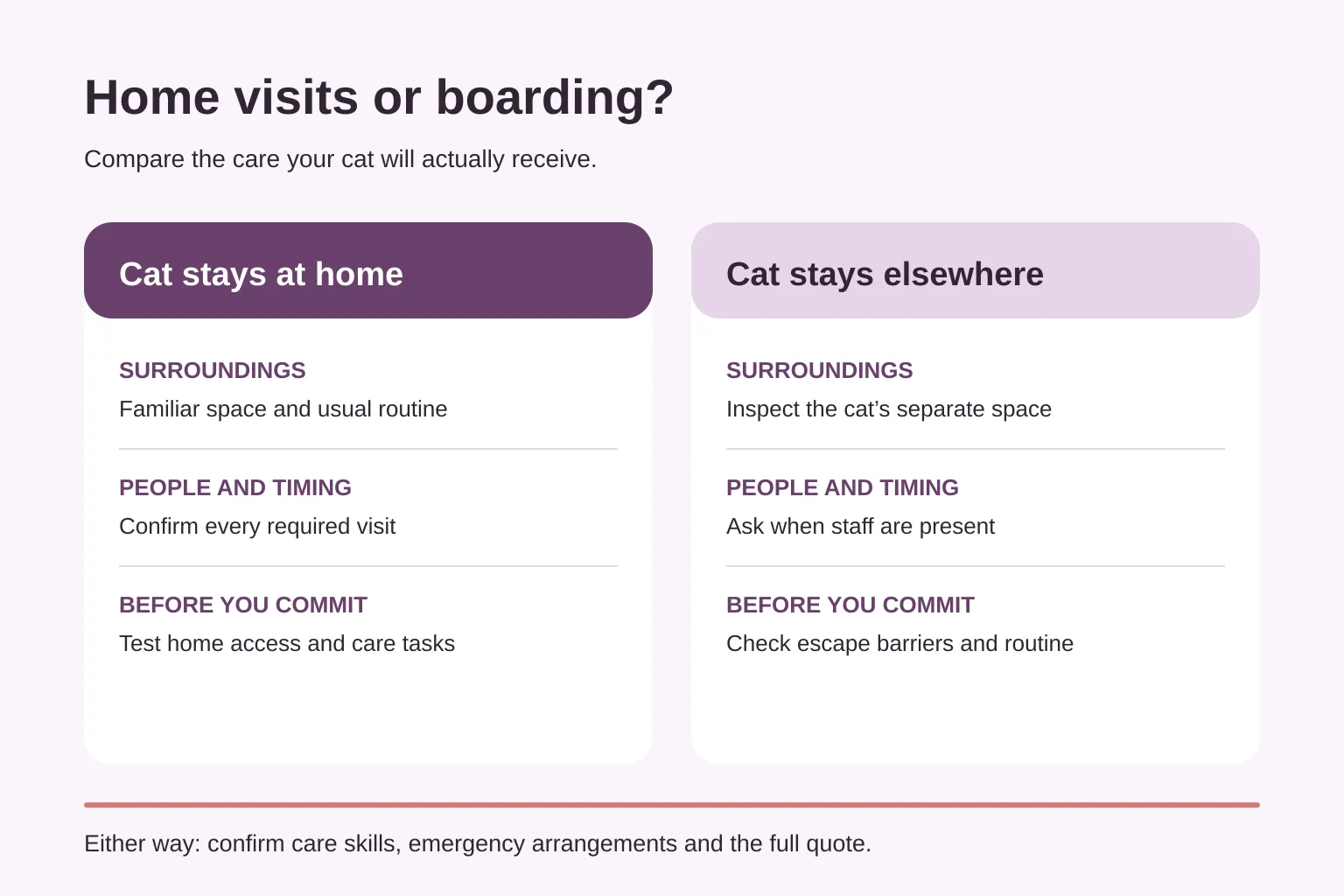
For cat sitting vs boarding, home care usually suits a cat who is comfortable in familiar surroundings, provided someone can deliver the full care routine. Boarding can be a workable alternative when suitable home care isn’t available and the accommodation fits your cat’s needs. Compare the actual visit schedule or on-site care, separate space and emergency plan; neither a friendly sitter nor a boarding label guarantees the right arrangement.
Cat sitting vs boarding: compare where care happens
Cat sitting means someone looks after your cat in your home, through visits or a stay. Cat boarding means your cat stays elsewhere, either at a boarding facility or in a host’s home. A host’s spare room and a purpose-built cattery can offer very different setups.
| Decision | Sitting at your home | Boarding elsewhere |
|---|---|---|
| Surroundings | Your cat keeps familiar rooms, smells and hiding places | Your cat travels and settles into a different space |
| Care coverage | Confirm visit times and length, or exactly when a live-in sitter will be home | Confirm staff or host presence, checks and overnight arrangements |
| Other animals | Your cat stays with the household they know | Inspect separation from unfamiliar cats and dogs |
| Preparation | Meet the sitter, rehearse tasks and test access | Visit the accommodation, check entry barriers and agree on the routine |
| Price | Compare the total for all visits or the full live-in stay | Compare all charged nights, transport and any extra care charges |
Cats Protection’s holiday guidance, checked in November 2026, favors keeping cats at home as the least unsettling option. It notes that nervous cats are likely to prefer home, while cats comfortable away from home may suit a carefully chosen cattery.
When is staying home the better fit?
Choose home care when your cat benefits from their usual environment and you can arrange dependable care for the whole absence. Cats Protection recommends home visits at least twice a day; very young or old cats and cats with certain health conditions may need more frequent visits.
The practical question is whether those visits meet your cat’s needs between them. A drop-in sitter isn’t present all day, and a live-in sitter may leave for work or other commitments. Ask how long the person will stay and what happens if your cat needs attention outside that time.
Once home care looks suitable, our neighbor-versus-paid-sitter comparison helps you choose the person. Use the cat sitter instructions checklist for the detailed handoff.
What should you check before choosing cat boarding?
Visit the actual space your cat would use, rather than choosing from lounge photos or a list of amenities. Cats Protection recommends inspecting catteries for escape prevention, separate accommodation, clean bowls and the ability to give any required medication. It advises avoiding direct contact with other cats because this can be stressful.
Ask the facility or home host:
- Where will my cat stay? Can unfamiliar animals enter that space, and can cats see one another?
- How is escape prevented? Look at doors, windows and the route from the carrier into the accommodation. Cats Protection recommends double doors or a safety corridor for catteries.
- Who is present, and when? Ask about daytime absences, overnight staffing and the frequency of checks. “Overnight boarding” describes the stay, not necessarily continuous observation.
- Can you follow this routine? Confirm food, litter, handling and any medication with the person doing the care.
- What happens if my cat becomes unwell? Agree on who contacts you, the veterinary arrangements and transport.
Cats Protection also recommends up-to-date vaccinations before a cattery stay. Ask the boarding provider for its admission requirements early enough to prepare, and book ahead rather than leaving the inspection until drop-off.
How do sitting and boarding prices compare in Bangalore?
Compare complete quotes for the same departure and return times. As one published reference—not a city average—Zauffy lists cat sitting at ₹60–₹300 per hour and home-based cat boarding at ₹350–₹1,000 per night. Both pages date their indicative bands to 29 August 2026 and say the exact price depends on the host and booking details. The boarding figures describe host-home stays, not cattery prices.
For sitting, check the number of visits and any minimum booking length. For boarding, check how nights are counted, collection times, food, transport and medication charges. A low starting price doesn’t tell you the trip’s total—or whether the care is suitable.
A five-night example: check the room before the price
Say you’re leaving Bangalore for five nights with a healthy adult cat who hides when unfamiliar animals visit. A sitter offers morning and evening visits and meets your cat at home. A boarding host offers a lower total, but says visiting cats share a room.
Home visits are the better fit here if the sitter can meet the routine and access checks. The shared room doesn’t suit this cat’s known response to unfamiliar animals. If home visits fall through, look for another capable sitter or suitable separate boarding accommodation rather than accepting communal housing simply because it’s available.
If you choose routine home visits in Bangalore, Mewtual lets you prepare a timed care need before joining, then review and publish it for nearby cat parents to consider. Helpers aren’t screened and help isn’t guaranteed, so meet the person and confirm the arrangement before relying on it.
Ask your vet which setting and level of observation suit your own cat if health, age or medication affects the care plan.